Api error Backups Are Not Configured on This Db Instance Configure the Backup and Try Again
This page describes how backups of your Cloud SQL instance work.
For step-by-stride directions for scheduling backups or creating an on-need backup, come across Creating and Managing On-Demand and Automated Backups.
For an overview of how to restore data to an instance from the backup, meet Overview of restoring an instance.
What backups provide
Backups help you restore lost information to your Deject SQL example. Additionally, if an example is having a problem, you can restore it to a previous state by using the backup to overwrite it. Enable automatic backups for any instance that contains necessary data. Backups protect your data from loss or damage.
Enabling automated backups, along with binary logging, is also required for some operations, such every bit clone and replica creation.
What backups cost
By default, for each instance, Cloud SQL retains vii automated backups, in improver to all on-demand backups. You can configure how many automated backups to retain. We charge a lower rate for backup storage than for other types of instances.
See the pricing page for more information.
Backups versus exports
Backups are managed past Cloud SQL according to retention policies, and are stored separately from the Cloud SQL instance. Deject SQL backups differ from an export uploaded to Cloud Storage, where yous manage the lifecycle. Backups encompass the entire database. Exports can select specific contents.
Fill-in and restore operations can't exist used to upgrade a database to a later on version. Y'all can but restore from a fill-in to an instance with the same database version.
To upgrade to a later on version, consider using the Database Migration Service or exporting and so importing your database to a new Cloud SQL instance.
Well-nigh backup size
Cloud SQL backups are incremental. They contain only data that changed afterwards the previous backup was taken. Your oldest backup is a similar size to your database, just the sizes of subsequent backups depend on the rate of alter of your data. When the oldest fill-in is deleted, the size of the next oldest backup increases so that a full fill-in still exists.
Types of backups
Deject SQL performs two types of backups:
- On-demand backups
- Automated backups
On-need backups
You lot can create a fill-in at any time. This could be useful if you are nearly to perform a risky performance on your database, or if you demand a fill-in and y'all do not want to await for the backup window. You can create on-need backups for whatsoever instance, whether the instance has automatic backups enabled or not.
On-demand backups are non automatically deleted the way automated backups are. They persist until you delete them or until their example is deleted. Because they are not automatically deleted, on-demand backups can have a long-term effect on your billing charges.
Automated backups
Automated backups apply a 4-hour fill-in window. The fill-in starts during the backup window. When possible, schedule backups when your instance has the least action.
During the fill-in window, automatic backups occur every day your case is running. The seven virtually recent backups are retained, by default. You can configure how many automated backups to retain, from i to 365. Backup and transaction log retention values tin be changed from the default setting. Larn more.
Where backups are stored
Backups locations include:
- Default locations that Cloud SQL selects, based on the location of the original example.
- Custom locations that you lot choose when you lot practise not want to use the default location.
Default backup locations
If you do not specify a storage location, your backups are stored in the multiregion that is geographically closest to the location of your Cloud SQL instance. For instance, if your Deject SQL instance is in us-central1, your backups are stored in the us multi-region past default. Yet, a default location like australia-southeast1 is outside of a multi-region. The closest multi-region is asia.
Custom backup locations
Cloud SQL lets you lot select a custom location for your fill-in data. This is useful if your organization needs to comply with data residency regulations that require you to continue your backups within a specific geographic purlieus. If your organization has this type of requirement, it probably uses a Resource Location Brake organizational policy. With this policy, when you attempt to apply a geographic location that does not comply with the policy, you meet an alarm on the Backups folio. If you see this alert, you need to alter the fill-in location to a location the policy allows.
For a complete list of valid regional values, encounter Case Locations. For a complete list of multi-regional values, run into Multi-regional locations.
Run into Setting a custom location for backups and Viewing locations for backups.
Automated fill-in and transaction log retentiveness
Automatic backups are used to restore a Cloud SQL instance. A combination of automated backups and transaction logs are used to perform a signal-in-fourth dimension recovery.
Automated backups can be retained for up to a year by configuring the retention period whereas on-demand backups persist until you delete the backups or until your case is deleted.
While transaction logs are counted in days, automatic backups are non guaranteed to occur on a day boundary. Dissimilar units are used for these retention settings. Automated fill-in retentiveness is a count and tin can be prepare from one to 365 backups. Transaction log retention is in days and can be set from one to seven. The default value for both is seven.
The lower premises are useful for test instances, considering logs and backups are deleted faster. For transaction logs, disk size doesn't grow every bit much with lower bounds. Using higher values for automated backups retention allow yous restore from farther back in fourth dimension.
Logs are purged once daily, non continuously. When the number of days of log retentivity is the same every bit the number of backups, insufficient log retention can result. For example, setting log retention to seven days and backup retentiveness to vii backups ways that between six and seven days of logs will exist retained.
We recommend setting the number of backups to at least one more than than the days of log retention to guarantee a minimum of specified days of log retention.
High write activeness to the database tin generate a big book of transaction logs, which tin consume meaning disk space, and lead to disk growth for auto storage increase enabled instances. Nosotros recommend sizing instance storage to account for transaction log retention.
Run across Setting automated fill-in retention.
See Setting transaction log retention.
Can I consign a backup?
No, y'all tin can't export a fill-in. You tin only export instance data. See Exporting data from Deject SQL.
Nigh the special backup user
Cloud SQL creates a special database user, cloudsqladmin, for each instance, and generates a unique case-specific password for it. Deject SQL logs in as the cloudsqladmin user to perform automated backups.
How backups touch on instance operations
For MySQL instances, the FLUSH TABLES WITH READ LOCK flag is not used for backups. This ways that writes and other operations are unaffected by fill-in operations.
Typically, backups complete inside a few seconds, but if a large amount of data has been written since the last backup, the backup takes longer to complete.
If there is a pending performance at the time of the backup attempt, Cloud SQL usually makes several attempts inside the window to complete the backup. Operations that block backup are long-running Cloud SQL instance operations such as import, export, update (for example, an instance metadata change), and instance restart.
During a long-running functioning, such as loading data, y'all tin can temporarily disable automated backups.
Backup rate limitations
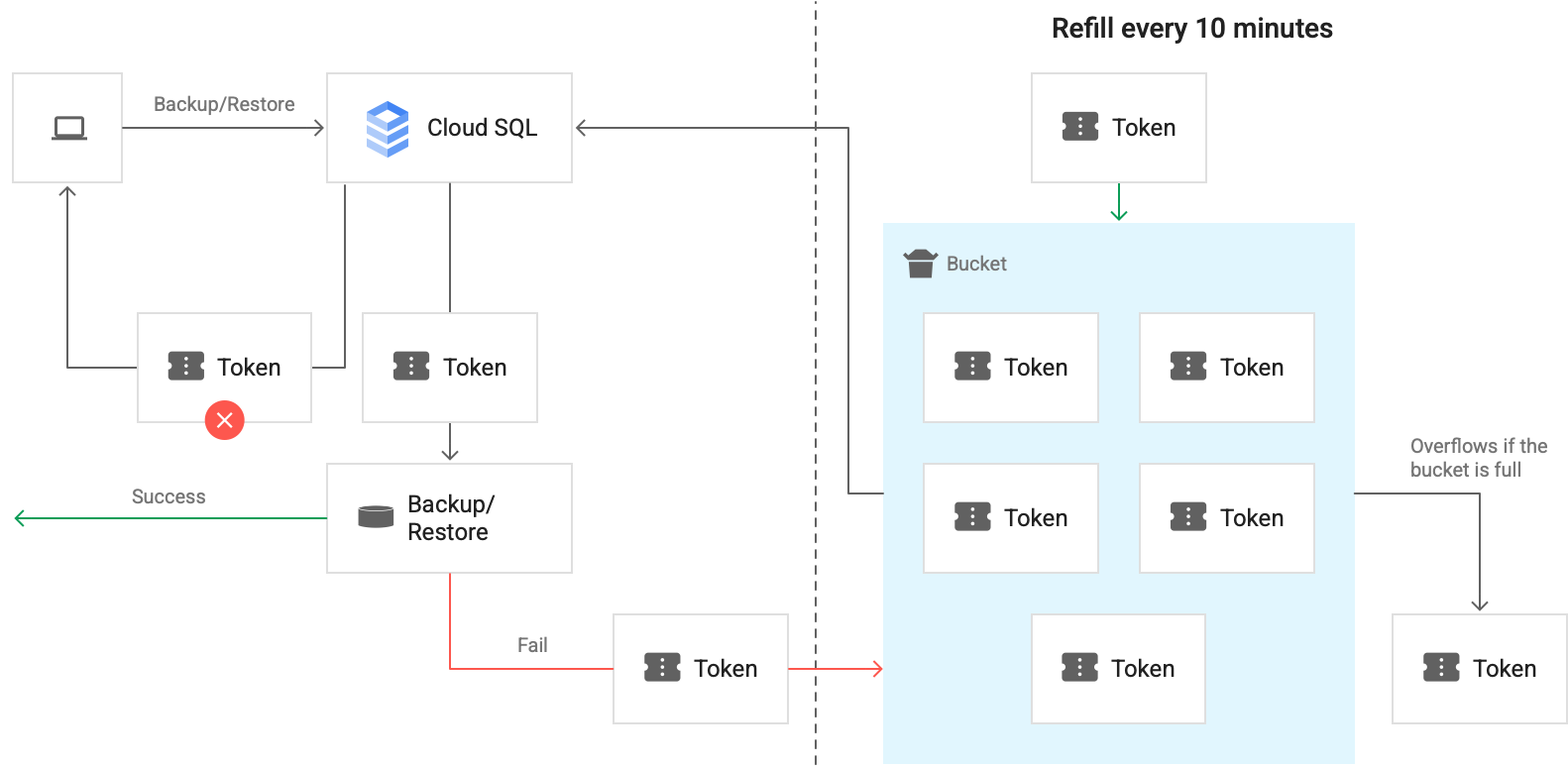
Cloud SQL limits the rate for backup operations on the data deejay. Y'all are allowed a maximum of 5 backup operations every l minutes per case per project. If a backup operation fails, information technology does non count towards this quota. If you reach the limit, the functioning fails with an error message that tells you when you tin retry.
Let's take a look at how Cloud SQL performs rate limiting for backups.
Deject SQL uses tokens from a bucket to determine how many backup operations are available at any one fourth dimension. Each instance has a saucepan. At that place'south a maximum of five tokens in the bucket that you can utilise for backup operations. Every 10 minutes, a new token is added to the saucepan. If the bucket is total, the token overflows.
Each fourth dimension you issue a backup operation, a token is granted from the saucepan. If the operation succeeds, the token is removed from the bucket. If it fails, the token is returned to the bucket. The following diagram shows how this works:
Troubleshooting
| Result | Troubleshooting |
|---|---|
| You tin can't meet the electric current operation's status. | The Google Cloud panel reports merely success or failure when the operation is done. Information technology isn't designed to testify warnings or other updates. Run the |
| You desire to discover out who issued an on-need backup performance. | The user interface doesn't testify the user who started an operation. Look in the logs and filter by text to discover the user. You lot may demand to utilize inspect logs for private data. Relevant log files include:
|
| Yous can't exercise a fill-in after an instance was deleted. | The grace flow for a Cloud SQL instance purge is iv days, with the exception of read replicas, which are purged immediately. During this time, client support can recreate the instance. If the instance is recreated, its backups are also recreated. After instances are purged, no data recovery is possible. If you have done an export operation, y'all can create a new instance and then practice an import functioning to recreate the database. Exports are written to Cloud Storage and imports are read from there. |
| An automated backup is stuck for many hours and can't be canceled. | Backups tin take a long time depending on the database size. If you really demand to cancel the performance, y'all tin enquire client support to |
| A restore operation can fail when one or more users referenced in the SQL dump file don't exist. | Earlier restoring a SQL dump, all the database users who own objects or were granted permissions on objects in the dumped database must exist in the target database. If they don't, the restore operation fails to recreate the objects with the original ownership or permissions. Create the database users before restoring the SQL dump. |
| Yous want to increment the number of days that you can proceed automatic backups from vii to 30 days, or longer. | Only seven backups are retained. Backups get pruned regularly due to the toll and size of retaining backups. Unfortunately, this means that the currently visible backups are the only automatic backups y'all can restore from. To keep backups indefinitely, you can create an on-demand backup, every bit they are not deleted in the aforementioned manner every bit automated backups. On-demand backups remain indefinitely. That is, they remain until they're deleted or the example they vest to is deleted. Because that blazon of fill-in is not deleted automatically, information technology can bear upon billing. |
| An automatic backup failed and you didn't receive an e-mail notification. | Notifications aren't supported for fill-in failures. When an automated backup fails, an Y'all can find the status of a backup through either the Rest API or gcloud sql backups list \ --project=PROJECT_ID \ --example=INSTANCE_ID gcloud sql backups describe Fill-in-ID \ --instance=INSTANCE_ID |
What'south side by side
- Schedule automatic backups.
- Create an on-demand backup.
- Restore from a backup.
Source: https://cloud.google.com/sql/docs/mysql/backup-recovery/backups
0 Response to "Api error Backups Are Not Configured on This Db Instance Configure the Backup and Try Again"
Post a Comment